
Everything you need to know
MSc in NLP
frequently
asked
questions
Explore our resources for detailed information on applications, fees and grants, housing and support services, and more!

Welcome to the FAQ of the MSc in Natural Language Processing! Here, you’ll find answers to common questions. We aim to support you as you navigate your journey in our programme, providing the information you need for a successful academic experience. If you have any additional questions or concerns, feel free to reach out!
GENERAL
In which language is the Master's taught? Is it possible to choose a different language?
The Master's is taught entirely in English. There is no option to choose other languages for instruction.
In addition to that, a complementary language course is offered: scientific English classes for non-English speakers and French classes for international students to facilitate their integration in France.
In addition to that, a complementary language course is offered: scientific English classes for non-English speakers and French classes for international students to facilitate their integration in France.
Are there language courses available at the University of Lorraine for non-native French speakers who want to learn French alongside their specialised courses?
Yes, the University of Lorraine and IDMC offer French language courses for non-native speakers.
Is the Master's RNCP certified?
Yes, it is. This certification ensures the programme meets high-quality standards for professional qualifications. You can find more information on the official RNCP webpage.
Is there a diverse international presence in the class? Are there many international students in the Master's?
Yes, over 75% of the students are international, fostering a dynamic and diverse environment. This international mix enhances language skills, cultural exchange, and networking opportunities. All students are fluent in English, and many also speak French, although it is not required to apply for this degree.
Is it mandatory to have a qualification in computer programming to apply for this degree?
No, a qualification in computer programming is not mandatory, but it is a strong asset for your application and will make it easier for you to succeed in your studies.
Is the internship the same as an "alternance"? If not, which is mandatory for M1 and M2?
The internship (in french: "stage") and apprenticeship (in french: "alternance") are different. In the context of the Master’s at the IDMC, the internship is mandatory in M2, while the apprenticeship is optional and involves alternating between work and study.
| M1 | M2 | |
| Apprenticeship “Alternance” |
/ | Optional |
| Internship “Stage” |
Optional (2-3 months, from June to August) | Mandatory (5-6 months, from February to August) if you are not in an apprenticeship |
What can I read or review to improve my NLP skills before classes start in September?
You can find a list of recommended readings and resources on this page. To prepare effectively, focus on familiarising yourself with algorithmic concepts and ensuring a strong foundation in Python programming.
APPLICATION AND ELIGIBILITY
Where/how do I apply to the Master's?
For Year 1 of the MSc in NLP ("Master 1 TAL"):
- Students living outside of the European Union: Apply via Études en France.
- Students living inside of the European Union: Apply via Mon Master.
- International students living in France: Apply via Mon Master.
- Students living outside of the European Union: Apply via Études en France.
- Students living inside of the European Union: Apply via e-candidat.
- International students living in France: Apply via e-candidat.
What are the requirements for applying to Year 1 ("Master 1")?
To apply for Year 1 ("Master 1"), you need to meet the following requirements:
- Academic qualifications: You must hold a "Bac+3" (equivalent to a bachelor's degree) or a qualification worth 180 ECTS credits. You can still apply if you haven't received your diploma yet, but please note that your acceptance will be conditional. If you do not obtain your diploma, you will not be allowed to register at the university.
- Relevant background: We accept applicants with a "Bac+3" (equivalent to a bachelor's degree) in computer science, mathematics, and/or linguistics (or related fields). Students are generally expected to have a basic understanding of mathematics, linguistics, and/or programming, and a good proficiency in English.
- Supporting documents: Certifications, proof of success, and other relevant documents will strengthen your application.
- Motivation letter: The admissions committee places significant importance on your motivation letter. It should reflect your understanding of the programme, its applications, and your genuine interest in the field.
Can I apply directly to Year 2 ("Master 2")?
We strongly recommend applying to Year 1 ("Master 1") instead. Admission to Year 2 ("Master 2") is highly selective, and it's generally more advantageous to complete the full programme starting from Year 1.
How can I increase my chances of being accepted?
Acceptance is determined by an admissions committee that reviews applications several times between January and June. The committee is responsible for making the final decision on admissions. To strengthen your application, ensure that you meet all the requirements, provide a compelling motivation letter, and highlight your relevant qualifications and experience.
I have a background in linguistics. Am I eligible for your programme?
Yes, you are eligible. There will be refresher courses in computer science and coding to help you strengthen your skills in these areas.
Are there specific credit or percentage requirements in programming and maths for linguistics majors?
There are no formal percentage requirements; however, demonstrating proficiency through relevant certifications or coursework can significantly enhance your application and better prepare you for the programme.
Can I include summer course credits or grades in my application?
Yes, you can include proof of summer courses with credits or grades to support your application.
Can I use certificates from MOOCs (e.g., Coursera or edX) to demonstrate my programming or math skills?
While not the preferred method, certificates from MOOCs such as Coursera or edX can be used as supplementary proof of your skills.
What documents should I provide to justify any gaps in my academic journey after obtaining my bachelor’s degree (or equivalent)?
You should provide employment contracts or other relevant documents to explain any gaps in your academic history. This helps the admissions committee understand your professional background during those times.
Can I submit recommendation letters from people other than my teachers?
Yes, you can submit recommendation letters from individuals other than your teachers, such as your employer, co-authors, or previous research supervisor. These references can provide valuable insight into your professional or research experience.
What languages can I use for the application documents?
You can submit your application documents in either English or French. You are free to submit a mix of documents in English and French—the jury is fluent in both languages. However, for registration, official translations of your results are required.
If I provide an official document from my university stating that my studies were in English, will it be accepted in lieu of a TOEFL/TOEIC/IELTS certificate?
Yes, an official document from your university proving that your studies were conducted in English can be accepted as a substitute for a TOEFL/TOEIC/IELTS certificate.
When will I know if I am accepted into the programme?
You will be informed of the jury's decision shortly after the selection round is completed. If you are accepted, you will receive an admission letter soon after, which you can use for administrative processes such as housing or visa applications.
What are the next steps after admissions?
Congratulations on your admission to the Master's! Here’s what you need to do next:
- You will receive an official admission letter and a list of documents required for your official registration.
- Use the admission letter to secure housing.
- With your housing confirmation, you can begin the visa application process.
FEES AND SCHOLARSHIPS
What are the tuition fees for the full programme?
Tuition fees depend on your nationality and the year of enrolment and are always subject to France's regulations and international agreements. For academic year 2026/2027:
For Year 1 of the MSc in NLP ("Master 1 TAL"):
For more information on fees according to your profile, please consult this page and refer to the section "Droits d’inscription pour les étudiants extracommunautaires".
For more information on differentiated tuition fees, please consult this page.
¹ European Economic Area: Austria, Belgium, Bulgaria, Croatia, Cyprus (Republic of), Czech Republic, Denmark, Estonia, Finland, France, Germany, Greece, Hungary, Iceland, Ireland, Italy, Latvia, Liechtenstein, Lithuania, Luxembourg, Malta, Netherlands, Norway, Poland, Portugal, Romania, Slovakia, Slovenia, Spain, Sweden.
² Organisation internationale de la Francophonie: Albania, Armenia, Benin, Burkina Faso, Burundi, Cabo Verde, Cambodia, Cameroon, Canada, Canada/New Brunswick, Canada/Quebec, Central African Republic, Chad, Comoros, Congo, Côte d'Ivoire, Democratic Republic of the Congo, Djibouti, Dominica, Egypt, Equatorial Guinea, Gabon, Guinea, Guinea-Bissau, Haiti, Laos, Lebanon, Madagascar, Mali, Mauritania, Mauritius, Moldova, Morocco, Niger, North Macedonia, Rwanda, Saint Lucia, São Tomé and Príncipe, Senegal, Seychelles, Togo, Tunisia, Vanuatu, Vietnam.
For Year 1 of the MSc in NLP ("Master 1 TAL"):
- Students from the European Economic Area¹: €255 per year ("community fees").
- Students from Switzerland, Monaco, Andorra or Quebec: €255 per year ("community fees").
- Students from outside the European Economic Area¹: €3,950 per year ("differentiated tuition fees").
- Students from the European Economic Area¹: €255 per year ("community fees").
- Students from Switzerland, Monaco, Andorra or Quebec: €255 per year ("community fees").
- Students from outside the European Economic Area¹: €3,950 per year ("differentiated tuition fees").
For more information on fees according to your profile, please consult this page and refer to the section "Droits d’inscription pour les étudiants extracommunautaires".
For more information on differentiated tuition fees, please consult this page.
¹ European Economic Area: Austria, Belgium, Bulgaria, Croatia, Cyprus (Republic of), Czech Republic, Denmark, Estonia, Finland, France, Germany, Greece, Hungary, Iceland, Ireland, Italy, Latvia, Liechtenstein, Lithuania, Luxembourg, Malta, Netherlands, Norway, Poland, Portugal, Romania, Slovakia, Slovenia, Spain, Sweden.
² Organisation internationale de la Francophonie: Albania, Armenia, Benin, Burkina Faso, Burundi, Cabo Verde, Cambodia, Cameroon, Canada, Canada/New Brunswick, Canada/Quebec, Central African Republic, Chad, Comoros, Congo, Côte d'Ivoire, Democratic Republic of the Congo, Djibouti, Dominica, Egypt, Equatorial Guinea, Gabon, Guinea, Guinea-Bissau, Haiti, Laos, Lebanon, Madagascar, Mali, Mauritania, Mauritius, Moldova, Morocco, Niger, North Macedonia, Rwanda, Saint Lucia, São Tomé and Príncipe, Senegal, Seychelles, Togo, Tunisia, Vanuatu, Vietnam.
What is the CVEC?
The CVEC ("Contribution à la Vie Étudiante et de Campus") is a mandatory contribution for all students, French or international. It helps fund various services provided by your university and the CROUS (the regional student services organisation). The amount is €105 for the 2025-2026 academic year. Some scholarships may cover the CVEC, so it’s important to check with your scholarship provider if you are eligible for coverage.
You do not need to pay the CVEC before applying for your visa, as the visa process is independent of this fee.
For more information on the CVEC, please consult this page.
You do not need to pay the CVEC before applying for your visa, as the visa process is independent of this fee.
For more information on the CVEC, please consult this page.
What are the available payment options for tuition fees?
Tuition fees can be paid either in a single instalment or in three instalments over three months. At the moment, no other arrangements can be made about the number of instalments. Payment periods typically run from September to November.
Please note that the option to pay in three instalments has a fixed deadline for registration.
Please note that the option to pay in three instalments has a fixed deadline for registration.
Can I pay the first instalment of the tuition fees before arriving in France, in order to get the confirmation document for visa purposes?
For students applying via the Études En France platform or with a direct application:
If you have concerns about visa requirements, your local embassy can contact us directly to confirm your acceptance, which may assist with your visa application process.
- In-person registration is required before you can proceed to the payment.
- Once your application is accepted by the admissions committee and the system opens for registrations, you may complete your registration and payment online. You will receive an email with detailed instructions for the registration and payment process.
If you have concerns about visa requirements, your local embassy can contact us directly to confirm your acceptance, which may assist with your visa application process.
Are there any scholarships offered by the university?
The university itself does not offer scholarships. However, international students can access various funding options such as:
- Erasmus programme grants.
- France Excellence Eiffel Scholarship programme.
- ORION Master Grant programme.
- Support from the French embassy in your country of origin.
- Scholarships and grants from your home country.
- French institutions like the CROUS for housing and living expenses.
Registration
When will I know if I am accepted into the Master’s programme? When will I receive my admission letter?
Results are sent to applicants shortly after the selection round is complete. You can expect to receive a response about 1 to 2 months after submitting your application. You will receive an email from Maxime AMBLARD with your acceptance notification. Shortly after, you will receive your official admission letter from Karine WEISSE.
My application has been accepted! What about registration?
Registration is conducted in person and begins in mid-July, continuing until September. Upon your arrival in France, please schedule an appointment with Karine WEISSE.
For your registration, you will need to provide both original documents and copies of the following:
For your registration, you will need to provide both original documents and copies of the following:
- Your letter of acceptance,
- Your ID card or passport,
- Your most recent diploma (a translation into English or French is accepted),
- Your high school diploma (a translation into English or French is accepted),
- Your CVEC certificate,
- Your civil liability certificate (usually included in your accommodation insurance in France),
- A small-sized photo suitable for ID or passport.
My application has been accepted! What are the next steps?
Here’s a brief overview of the administrative process:
Admission Confirmation:
Don’t worry, you’re going to have a fantastic time here!
Admission Confirmation:
- If you applied directly, you will receive an official admission letter from Karine WEISSE via email (in PDF format).
- If you applied through Campus France or Études en France, you will receive the admission letter through the website.
- Use the admission letter to book accommodation. Please note that a guarantor (e.g., Visale guarantee) is required.
- Use the accommodation certificate to apply for a visa. Keep in mind how long you’ll be staying for.
- Obtain proof of residence once you have moved in.
- Use the proof of residence to open a bank account.
- The CVEC fee (€103) can be paid after your arrival and before your in-person registration at the IDMC.
- Schedule an appointment with Karine WEISSE, during which you'll be able to pay the fees and complete your official registration at the IDMC.
- Complete any remaining formalities, including social security, "mutuelle" (additional coverage for your health insurance), and CAF (financial aid).
Don’t worry, you’re going to have a fantastic time here!
How do I receive the admission letter?
- If you applied via email, you will receive a PDF admission letter from the university, sent via by Karine WEISSE.
- If you applied through Campus France or Études en France, you will receive your admission letter via their platform.
Does the admission confirmation email serve as the official admission letter, or will another document be sent?
The admission letter sent by Karine WEISSE is the official document you will receive. It will be sent shortly after the admission confirmation email from Maxime AMBLARD. You can use this letter for housing applications, scholarship requests, or if an official document is required by your embassy or consulate.
Are any university fees required to be paid before the visa application?
No fees are required prior to your visa application. Tuition fees are independent of the visa process, and the issuance of a visa is not contingent upon paying university fees.
Could you please provide information about the deadlines for registering for the Master's programme and securing accommodation through the university?
To provide an overview, here’s a general outline of the admission process. Please be aware that the dates and deadlines are subject to change each year, so this serves as an approximation.
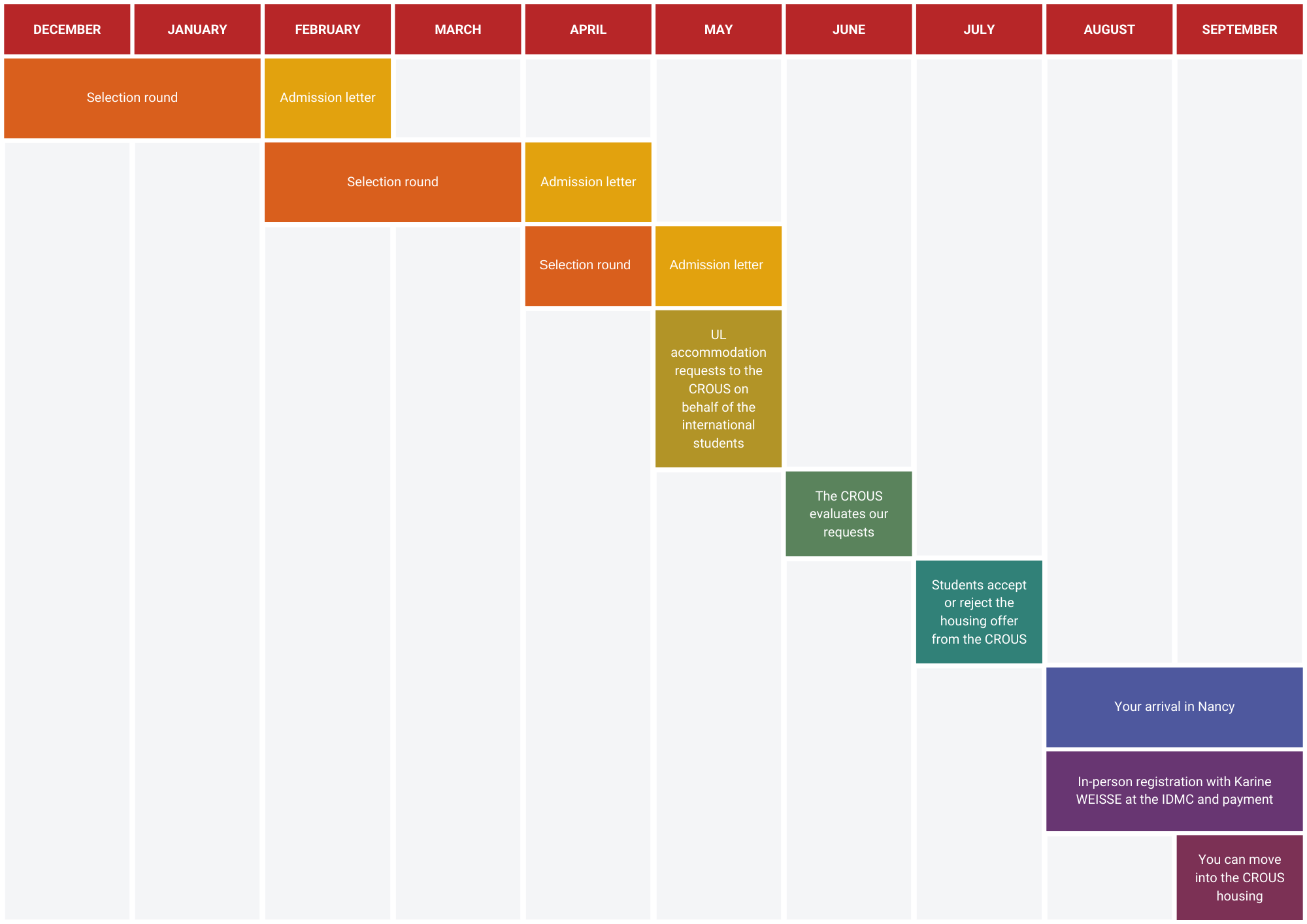
For the most up-to-date deadlines, please refer to the dates provided on the application platform you are using (Études En France, Mon Master, e-candidat).
For the most up-to-date deadlines, please refer to the dates provided on the application platform you are using (Études En France, Mon Master, e-candidat).
Can you assist with personal affairs such as housing, health, and banking? What is the recommended order for handling these tasks?
- Housing: We forward housing applications to the CROUS housing department starting in May. Additionally, two student relays are available to assist you with housing and other queries during July, August, and September.
- Health and Banking: International students are responsible for managing health insurance and banking arrangements independently. You will need to handle these matters on your own, but resources and advice are available to help you navigate these processes.
HOUSING AND HEALTH
What are CROUS accommodations? Are there different types to choose from?
CROUS housing options are student residences managed by the CROUS organisation in Nancy. You can explore the available options here.
If you have specific criteria or are in a precarious situation, please let us know so we can include this information on the form the IDMC sends to the CROUS. Otherwise, accommodation will be allocated based on availability and proximity to your study location.
Changes to assignments are not possible once allocated. If you wish to change your accommodation, you will need to refuse the initial offer and directly contact the CROUS to select another option from what remains available, with no guarantee of finding a viable option.
If you have specific criteria or are in a precarious situation, please let us know so we can include this information on the form the IDMC sends to the CROUS. Otherwise, accommodation will be allocated based on availability and proximity to your study location.
Changes to assignments are not possible once allocated. If you wish to change your accommodation, you will need to refuse the initial offer and directly contact the CROUS to select another option from what remains available, with no guarantee of finding a viable option.
Can I live with my partner or pet in CROUS accommodation?
CROUS accommodation is only available for single occupancy and does not permit pets.
Can I stay in CROUS housing for two years?
CROUS housing can be provided for one or two years. The process is fairly straightforward for the second year: you’ll need to submit a renewal application. As long as the form is completed correctly, you can remain in your accommodation.
Can I move into the CROUS accommodation before September?
You will need to inquire directly with your assigned CROUS residence about the possibility of moving in before September.
Are all students placed in CROUS accommodations?
No, not all students will be housed in CROUS accommodation. Due to limited availability, some students find housing through other options, such as alternative student residences like Apheen or Les Abeilles, or through private listings on classified ad sites like LeBonCoin.
What should I do if I don't have a guarantor to secure housing?
If you don't have a French or European guarantor, there are guarantee systems available to help you secure housing.
- For students between 18 and 30 years of age, Visale provides free assistance (in French only) and requires proof of identity and enrolment, such as your admission letter or enrolment certificate. Visale has a partnership with the University of Lorraine, making it a convenient option. You can learn more by checking out this article and watching this video.
- GarantMe is available, also offering a free service (in French only). To apply, you'll need proof of identity, proof of enrolment, and income documentation, with savings proof being optional.
Does the University provide any health services?
Yes, the "Service de Santé Étudiante" (SSE — Student Health Services) offers various health services to students. These include free and confidential consultations such as psychological support, screenings for STDs, and medical visits.
If you have health issues that may impact your studies, the university can arrange exam accommodations based on recommendations from the Student Health Services team.
For more information, visit this page.
If you have health issues that may impact your studies, the university can arrange exam accommodations based on recommendations from the Student Health Services team.
For more information, visit this page.
Are there local doctors who speak foreign languages?
Yes, some local doctors speak foreign languages. To find them, you can use "Doctolib" (browser or app). When looking up health professionals, you can filter the results with your preferred languages.
APPRENTICESHIP ("ALTERNANCE")
What is an apprenticeship ("alternance" in French)?
An apprenticeship is a work-study arrangement where students in our Master’s programme can sign a contract with a company or, less commonly, a laboratory, to gain practical experience alongside their studies. This typically involves alternating periods of work at the company and study at the IDMC according to a set calendar each year.
Apprenticeships offer numerous benefits, including networking opportunities, quick professional integration, hands-on training from industry professionals, and the ability to apply classroom knowledge in real-world settings.
While it is not mandatory, securing an apprenticeship contract is a good idea as soon as your application is accepted and your registration is confirmed.
Students are also free to seek part-time work in addition to their studies if they prefer.
Apprenticeships offer numerous benefits, including networking opportunities, quick professional integration, hands-on training from industry professionals, and the ability to apply classroom knowledge in real-world settings.
While it is not mandatory, securing an apprenticeship contract is a good idea as soon as your application is accepted and your registration is confirmed.
Students are also free to seek part-time work in addition to their studies if they prefer.
Who is eligible for an apprenticeship?
To sign an apprenticeship contract in France, students must generally be between the ages of 16 and 29 (included). However, certain individuals aged 30 and over can also qualify, including:
- Apprentices pursuing a diploma or certificate at a higher level than one earned in a previous apprenticeship,
- Individuals with disabilities,
- Those needing a diploma or certification for a business creation or takeover project,
- High-level athletes.
As an international student, can I apply for an apprenticeship?
Yes, you can apply for an apprenticeship, as long as you meet the age requirement (between 16 and 29 years of age).
What is the schedule for the apprenticeship programme for this year?
The detailed schedule is available on this page.
The programme alternates between weeks of classes at the university and weeks working in a company. Exams are scheduled during the "course" weeks.
If you do not have an apprenticeship, please note that during these dedicated weeks, you will have to complete university projects that students with apprenticeships do not have to manage.
The programme alternates between weeks of classes at the university and weeks working in a company. Exams are scheduled during the "course" weeks.
If you do not have an apprenticeship, please note that during these dedicated weeks, you will have to complete university projects that students with apprenticeships do not have to manage.
Can I do an apprenticeship abroad?
No, apprenticeships are only available in France. Both the student and the company must be located in France, as this type of contract is specific to the country.
Can I work remotely during my apprenticeship?
In very rare and specific cases, remote work may be considered for apprenticeships, but it can be challenging for students. We would need to discuss this further to assess its feasibility.
What makes a good apprenticeship topic?
Any apprenticeship you apply to will need to have an NLP component and be reviewed by the Head of the Master. It’s the student's responsibility to find a suitable company and define their topic. Some companies focus entirely on NLP, while others may have dedicated NLP departments as part of a broader range of activities.
I found an apprenticeship! What should I do next?
To formalise an apprenticeship, several steps must be completed in coordination with the CFA (Apprentice Training Centre), the employer, and the university. The process is outlined below:
- Candidate Admission and Project Approval
- The student’s admission to the Master’s programme must be confirmed, and their professional project approved by the head of the programme.
- Requests to set up the apprenticeship contract and financial approval (if required for public employers) are initiated at this stage.
- Preparation of the Application File
- The CFA prepares the applicant’s file, which includes details about the employer, the apprentice, and the apprenticeship position.
- Completion of Information Sheets
- The employer and the future apprentice each fill in their respective information sheets to ensure all necessary details are provided.
- Preparation of the Official Agreement
- The CFA creates the official CERFA form (regulated administrative document) and the apprenticeship training agreement.
- These documents are sent to the employer for review.
- Signing the Agreement
- Both the employer and the apprentice sign the agreement to formalise the apprenticeship.
- Verification and Approval
- The CFA reviews the signed agreement and verifies all details before granting final approval.
- Submission of the Application
- The employer submits the apprentice’s application to their OPCO (funding and support organisation) or DREETS (regional directorates for economy, employment, labour, and solidarity) to secure funding and validate the contract.
- Coverage Approval
- The OPCO, CNFPT (public services centre), or other relevant public employer confirms coverage for the apprenticeship, finalising the process.
Are there days off to prepare for exams if I have an apprenticeship?
Apprentices are entitled to a total of 5 additional working days off to prepare for exams over the entire duration of the Master's programme (2 years). These days must be taken during the month leading up to the exams and should be coordinated with your company’s schedule. If you have already used some of these days, they will be deducted from your total allowance.
MSc in NLP coordination
Questions about the programme, tracks, applications & admissions, tuition fees, ..
English, French
English, French
International Students Services (DRIE)
Visa procedures, help and formalities upon arrival
English, French
English, French